Venue Management Explained: Impact on Event Success
Over 60 percent of American corporate events cite superior venue management as the driving force behind client satisfaction and repeat bookings. For event planners in Marrakech handling international delegations, understanding the details of professional venue management is now non-negotiable. This guide delivers clear insights to help you master the art of managing world-class spaces, impressing even the most discerning American and European guests while minimizing risks and maximizing event success.
Table of Contents
- Defining Venue Management In Events
- Main Types And Unique Venue Needs
- Core Duties Of Venue Managers
- Legal, Safety, And Compliance Essentials
- Risks, Costs, And Common Pitfalls
- Venue Management Vs. Event Management
Key Takeaways
| Point | Details |
|---|---|
| Venue Management is Essential | Successful events rely on effective venue management, which requires strategic planning and coordination of logistics, resources, and compliance. |
| Understanding Venue Types is Crucial | Different venue types, such as hotels and conference centers, have unique characteristics that must align with event objectives for optimal outcomes. |
| Risk Management is Key | Anticipating and mitigating risks, including technical failures and budget overruns, is vital for ensuring smooth event execution. |
| Collaboration Between Roles | Venue management and event management are distinct yet interdependent, necessitating seamless communication for successful event implementation. |
Defining Venue Management in Events
Venue management represents the strategic orchestration of event spaces to ensure seamless, successful experiences. At its core, venue management involves comprehensive coordination of all activities required to transform physical spaces into exceptional event environments.
This multifaceted discipline encompasses a wide range of responsibilities. Event professionals must handle complex logistical challenges including space allocation, vendor coordination, equipment management, safety compliance, and operational execution. A skilled venue manager functions like an orchestra conductor – carefully synchronizing multiple elements to create a harmonious attendee experience.
Venue management goes beyond mere logistics. It requires deep understanding of client expectations, meticulous planning, and adaptive problem-solving skills. Managers must anticipate potential challenges, maintain flexible operational protocols, and create environments that not only meet but exceed attendee and client expectations. This involves strategic scheduling, precise resource management, and continuous performance optimization.
Pro Tip: Always develop comprehensive venue contingency plans that address potential technical failures, scheduling conflicts, and unexpected logistical challenges to ensure smooth event execution.
Main Types and Unique Venue Needs
Event venues represent diverse environments designed to accommodate specific gathering requirements. Venues vary significantly in size and function, ranging from intimate conference rooms to expansive convention centers. Understanding these variations is crucial for event planners seeking to match the perfect space with their unique event objectives.
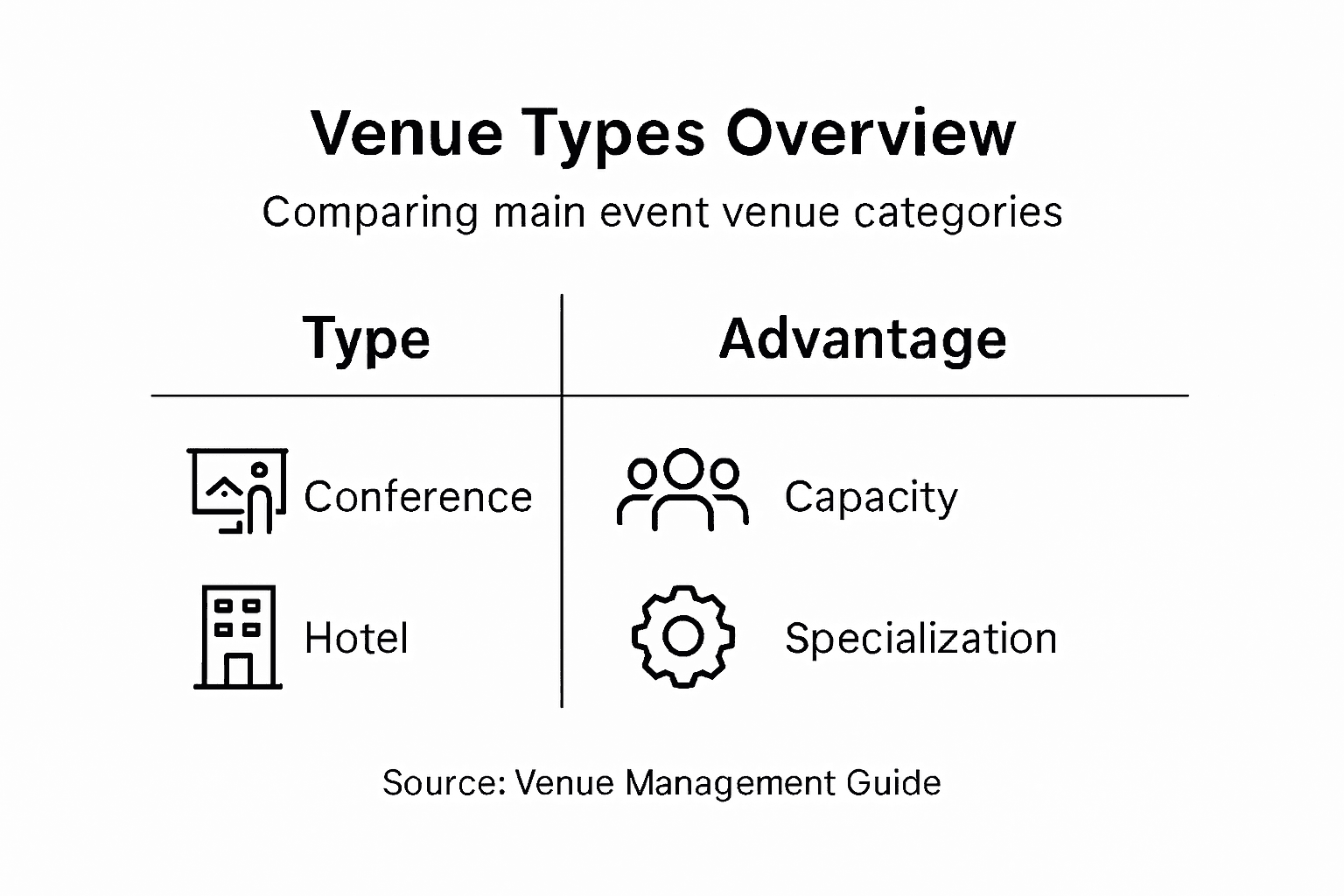
The primary venue categories include conference centers, hotels, resorts, academic facilities, and specialized spaces like breweries and wineries. Each type brings distinct advantages and operational characteristics. Conference centers typically offer large, flexible spaces ideal for trade shows and corporate events. Hotels provide integrated services including accommodations and catering, while academic venues offer sophisticated technological infrastructure with professional support environments.
Choosing the right venue requires careful analysis of event specifications. Considerations include anticipated attendee count, technological requirements, accessibility, budget constraints, and desired atmospheric ambiance. Specialized venues like cultural centers or historic locations can add unique character to events, while standard corporate spaces prioritize functionality and efficiency. Event managers must conduct thorough venue assessments, examining spatial layouts, technical capabilities, and potential logistical challenges before making final selections.
Here’s an overview of common event venue types and their distinctive characteristics:
| Venue Type | Typical Capacity | Key Advantage | Typical Use Case |
|---|---|---|---|
| Conference Center | 200-5,000 | Flexible layouts | Trade shows, conventions |
| Hotel | 50-1,000 | Onsite lodging and catering | Corporate meetings, banquets |
| Resort | 100-2,000 | All-inclusive amenities | Retreats, destination events |
| Academic Facility | 50-1,500 | Advanced tech infrastructure | Seminars, lectures |
| Specialized Venue | 10-500 | Unique atmosphere or theme | Private parties, tastings |
Pro Tip: Create a comprehensive venue evaluation checklist that systematically assesses technical capabilities, spatial requirements, and potential operational limitations before finalizing your event location.
Core Duties of Venue Managers
Venue managers play a critical role in creating exceptional event experiences through comprehensive operational oversight. Core responsibilities encompass complex organizational management, requiring a diverse skill set that balances strategic planning with hands-on execution. These professionals serve as the central nervous system of event spaces, coordinating multiple interconnected elements to ensure seamless operations.
The primary duties of venue managers include strategic booking management, staff supervision, and logistical coordination. They are responsible for negotiating vendor contracts, managing facility maintenance, implementing safety protocols, and maintaining precise administrative records. Budget management becomes a critical aspect of their role, requiring financial acumen to balance operational costs with revenue generation while ensuring optimal venue performance and client satisfaction.

Beyond operational tasks, venue managers must excel in problem-solving and communication. They serve as intermediaries between event clients, vendors, technical staff, and facility teams, requiring exceptional interpersonal skills and the ability to anticipate and resolve potential challenges quickly. Their role demands a holistic approach that integrates technical knowledge, financial understanding, and exceptional leadership capabilities to create memorable and successful event experiences.
Pro Tip: Develop a comprehensive digital dashboard that tracks venue metrics, vendor performance, and operational challenges to streamline decision-making and proactively address potential issues.
Legal, Safety, and Compliance Essentials
Venue management requires a comprehensive approach to legal and safety protocols that extend far beyond basic operational requirements. Navigating complex legal and regulatory landscapes demands meticulous attention to local, state, and federal regulations governing event spaces. Event professionals must develop robust frameworks that address potential risks, protect attendee safety, and ensure full compliance with evolving legal standards.
Key compliance areas include crowd management, emergency preparedness, licensing requirements, and data protection regulations. Venue managers must implement rigorous security measures that align with industry standards, covering critical aspects such as capacity limits, emergency exit protocols, fire safety regulations, and accessibility requirements. Understanding nuanced legal obligations becomes crucial, as non-compliance can result in significant financial penalties, potential legal action, and permanent venue restrictions.
Comprehensive risk management extends beyond immediate physical safety to include intricate considerations of data privacy, insurance coverage, and contractual obligations. Event professionals must develop multilayered compliance strategies that integrate technological solutions, staff training, and proactive risk assessment. This holistic approach requires continuous education, regular policy updates, and a dynamic understanding of emerging legal and safety standards across different event types and venue configurations.
Pro Tip: Create a comprehensive digital compliance checklist that includes real-time updates on legal requirements, automated risk assessment tools, and instant verification of safety protocols across different event scenarios.
Risks, Costs, and Common Pitfalls
Venue management involves navigating a complex landscape of potential risks and financial challenges that can significantly impact event success. Critical risks encompass multiple operational dimensions, ranging from technical infrastructure failures to budget miscalculations that can derail even the most meticulously planned events. Understanding these potential vulnerabilities becomes crucial for proactive event professionals seeking to mitigate potential disruptions.
The most prevalent risks include technological breakdowns, unexpected facility limitations, and vendor coordination challenges. Audio-visual equipment failures, inadequate internet connectivity, and space configuration problems can create cascading operational issues that compromise attendee experiences. Budget overruns represent another significant risk, with unexpected expenses potentially consuming profit margins and creating financial strain. Venue managers must develop comprehensive contingency plans that include financial reserves, backup technical systems, and flexible logistical arrangements to address potential complications.
Successful risk management requires a multifaceted approach that integrates strategic planning, continuous monitoring, and adaptive problem-solving. Event professionals must conduct thorough venue assessments, implement robust communication protocols, and develop multilayered backup strategies. This approach involves detailed site inspections, comprehensive vendor vetting, advanced technological redundancies, and flexible contractual arrangements that provide financial and operational protection against potential disruptions.
Pro Tip: Develop a digital risk management dashboard that tracks potential vulnerabilities in real-time, allowing immediate identification and mitigation of operational challenges before they escalate.
Venue Management vs. Event Management
While often used interchangeably, venue management and event management represent distinct professional disciplines with unique responsibilities and strategic focuses. Complementary roles with critical differences emerge when examining their core operational objectives, highlighting the specialized nature of each professional domain.
Venue management concentrates on the long-term operational excellence of physical spaces. This discipline involves comprehensive facility maintenance, year-round staffing coordination, infrastructure management, compliance oversight, and ensuring the venue’s financial sustainability. Event managers, by contrast, focus on the tactical execution of specific events, handling intricate logistics like programming, vendor coordination, attendee experience design, and short-term event-specific planning and implementation.
The relationship between venue and event management is fundamentally collaborative yet strategically differentiated. Venue managers create and maintain the operational infrastructure that enables successful events, while event managers leverage these prepared environments to deliver memorable attendee experiences. Their interdependence requires seamless communication, shared technological platforms, and mutual understanding of each discipline’s unique challenges and objectives. Successful event ecosystems depend on the symbiotic relationship between these two professional domains, each contributing specialized expertise to create exceptional gathering experiences.
The comparison below highlights crucial differences between venue management and event management:
| Aspect | Venue Management | Event Management |
|---|---|---|
| Core Focus | Facility operations and upkeep | Specific event execution |
| Time Horizon | Year-round, ongoing | Project-based, event-specific |
| Main Responsibility | Staffing, maintenance, compliance | Attendee experience, logistics |
| Financial Perspective | Revenue streams, cost control | Budget allocation, expenditure |
Pro Tip: Develop integrated communication protocols and shared digital management platforms that enable real-time information exchange between venue and event management teams to optimize operational efficiency.
Elevate Your Event Success with Expert Venue Management
Navigating the complexities of venue management is essential to delivering flawless and memorable events. Challenges such as coordinating logistics, ensuring compliance with safety standards, managing budgets, and selecting the perfect space demand expertise and attention to detail. Whether you struggle with balancing operational duties or aligning venue capabilities with your event goals, it is clear that strategic venue management directly impacts the success of your gathering.
At Morocco Events: Morocco’s Premier Event and Wedding Planner, we understand these critical demands. Our professional team brings extensive experience in venue sourcing, logistical coordination, and compliance management tailored to the unique expectations of clients hosting corporate conferences, luxury weddings, and international seminars across Morocco. By blending modern technology with a deep knowledge of Moroccan venues, we provide personalized solutions that exceed expectations and overcome common pitfalls.
Take control of your next event’s success today by partnering with a trusted team committed to flawless execution. Explore our full range of event planning services on MoroccoEvents.com to discover how we simplify venue management challenges and elevate your event experience.
Frequently Asked Questions
What is venue management?
Venue management refers to the strategic orchestration of event spaces to ensure seamless and successful experiences, encompassing responsibilities like space allocation, vendor coordination, safety compliance, and logistical execution.
How does venue management impact event success?
Effective venue management enhances event success by ensuring proper planning, resource management, and contingency strategies that address potential challenges, ultimately creating a harmonious attendee experience.
What are the key responsibilities of a venue manager?
Key responsibilities of a venue manager include booking management, staff supervision, logistical coordination, vendor contract negotiations, facility maintenance, and ensuring compliance with legal and safety protocols.
How can a venue manager mitigate risks in event planning?
A venue manager can mitigate risks by developing comprehensive contingency plans, conducting thorough venue assessments, implementing robust communication protocols, and maintaining financial reserves for unexpected challenges.
Recommended
- Event Management Explained: Complete Professional Guide – Morocco Events
- What Is Sports Event Management? Complete Guide – Morocco Events
- Sports Event Management Guide for Seamless Event Success – Morocco Events
- What Is Event Planning and Why It Matters – Morocco Events
- What Makes a Great Event Band for Corporate Success