Role of Technology in Event Planning: Transforming Experiences
Over eighty percent of American event planners now rely on advanced technology to manage complex events. In Marrakech, Morocco, this digital transformation is reshaping how coordinators deliver customized experiences and flawless logistics for high-profile clients. With new tools ranging from AI-powered management platforms to immersive media and hybrid event solutions, planners can exceed expectations and design unforgettable occasions while staying ahead in a competitive industry.
Table of Contents
- How Technology Reshapes Event Planning Today
- Key Types of Event Technology Solutions
- AI, Automation, And Data-Driven Personalization
- Hybrid Events, Virtual Platforms, And Immersive Media
- Risks, Challenges, And Cost Implications
- Choosing The Right Technology Partners And Tools
Key Takeaways
| Point | Details |
|---|---|
| Leverage Technology for Efficiency | Event planners should utilize AI-powered tools to streamline tasks like attendee registration and scheduling, enhancing overall event management efficiency. |
| Embrace Hybrid and Virtual Formats | Organizations must adopt hybrid event technologies to increase accessibility and participant engagement, merging in-person and remote experiences effectively. |
| Focus on Data-Driven Personalization | Implementing data analytics can help create highly tailored attendee experiences, ensuring that events meet individual preferences and needs. |
| Evaluate Technology Partners Thoroughly | A strategic approach to selecting technology partners is essential, focusing on compatibility, support, and alignment with event goals to maximize success. |
How Technology Reshapes Event Planning Today
The event planning landscape is undergoing a radical transformation driven by technological innovations that are redefining how professionals design, execute, and measure event experiences. Modern event planners now leverage sophisticated digital tools that dramatically enhance efficiency, engagement, and personalization. Emerging technologies are revolutionizing event management across multiple dimensions, creating unprecedented opportunities for creativity and strategic execution.
Digital platforms have fundamentally reshaped event logistics by introducing powerful capabilities like real-time collaboration, advanced data analytics, and seamless communication channels. Planners can now utilize AI-powered event management systems that automate complex tasks such as attendee registration, schedule optimization, and personalized communication. Virtual and hybrid event technologies have expanded geographic boundaries, allowing organizations to host conferences, workshops, and networking sessions that transcend physical limitations. These platforms enable simultaneous in-person and remote participation, increasing accessibility and reach while reducing traditional logistical constraints.
Technology has also transformed attendee experiences through immersive engagement tools. Augmented reality (AR) and interactive digital interfaces now allow event participants to engage with content in dynamic, personalized ways. Sophisticated event apps provide real-time scheduling, interactive maps, networking features, and live polling capabilities that enhance participant interaction and information retention. Data analytics further empower event planners by generating insights into attendee behavior, preferences, and engagement levels, enabling more targeted and meaningful event design.
Pro tip: Invest in integrated event technology platforms that offer comprehensive management features, allowing seamless coordination between registration, communication, and analytics tools.
Key Types of Event Technology Solutions
Event technology has evolved into sophisticated solutions that categorically transform how professionals plan, execute, and measure event experiences. Advanced technology solutions now encompass three primary categories that address different aspects of event management: media technology, immersive technology, and smart consumer-assistive technology. These innovative platforms provide event planners with unprecedented capabilities to enhance attendee engagement, streamline operations, and create memorable interactive experiences.
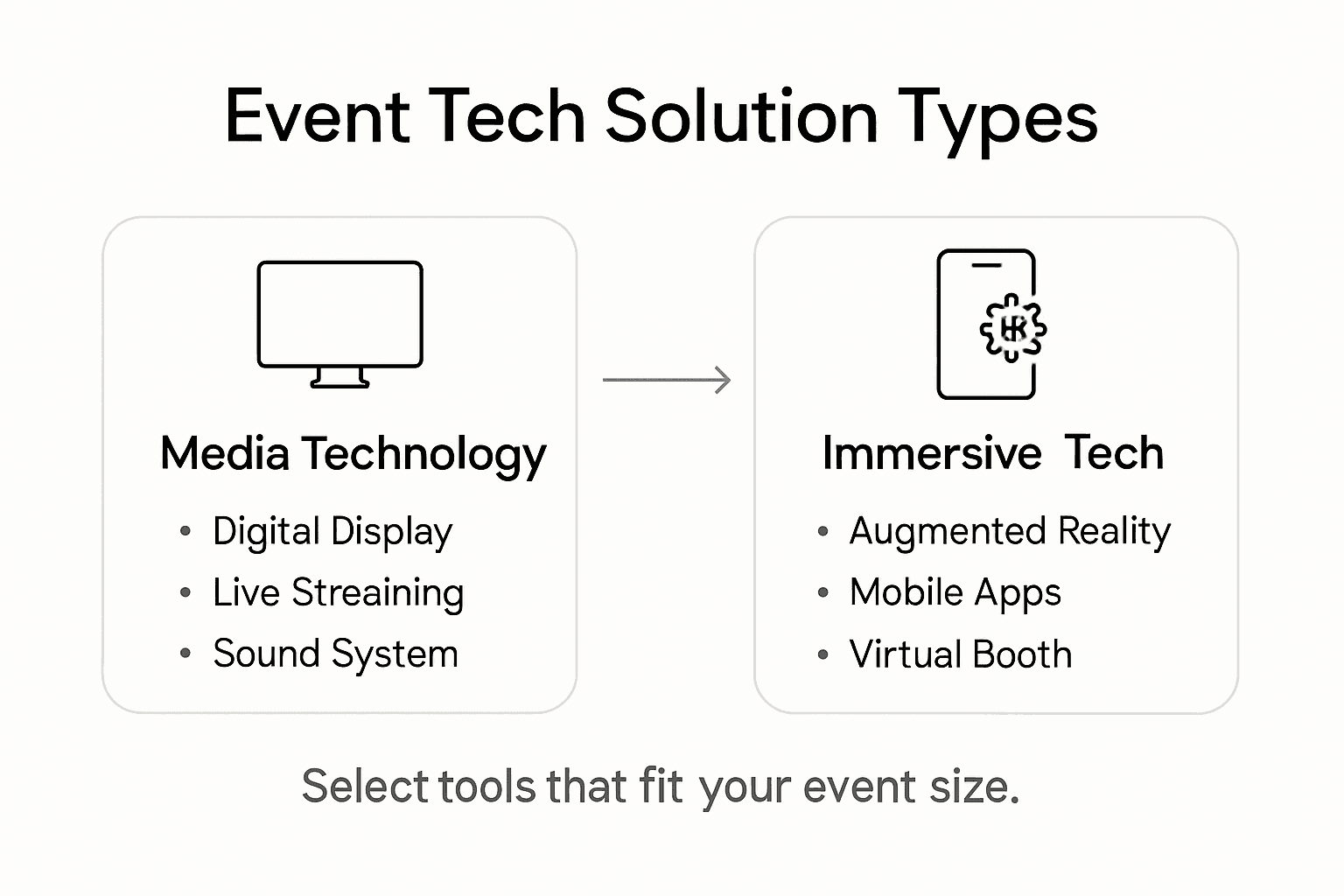
Media technologies represent the first critical category of event technology solutions. These tools include advanced digital platforms for content creation, live streaming, and multimedia production. Interactive digital displays, real-time translation services, and multichannel communication systems enable event organizers to create dynamic, engaging presentations that transcend traditional communication barriers. Virtual communication platforms have become particularly powerful, allowing seamless integration of remote and in-person participants through high-quality video conferencing, collaborative digital workspaces, and interactive networking environments.
Immersive technologies constitute another transformative category of event technology solutions. Mobile and augmented reality technologies enable innovative engagement strategies that dramatically enhance participant experiences. Virtual reality (VR) applications can provide virtual venue tours, interactive product demonstrations, and gamified learning experiences. Augmented reality (AR) interfaces allow real-time information overlays, interactive exhibits, and personalized navigation experiences that make events more engaging and informative. These technologies create multisensory environments that captivate attendees and provide unprecedented levels of interaction and knowledge transfer.
Pro tip: Select event technology solutions that offer seamless integration and scalability, ensuring your platforms can adapt to changing attendee expectations and technological advancements.
Here’s a summary of the main categories of event technology solutions and their core benefits:
| Technology Category | Primary Purpose | Key Benefits |
|---|---|---|
| Media Technology | Content delivery and communication | Enhanced audience reach |
| Immersive Technology | Create interactive experiences | Higher attendee engagement |
| Consumer-Assistive Technology | Personalization and convenience | Streamlined logistics |
AI, Automation, and Data-Driven Personalization
Artificial intelligence and automation are revolutionizing event planning by introducing unprecedented levels of efficiency, personalization, and strategic insight. Machine learning algorithms now enable event professionals to predict attendee preferences, optimize scheduling, and create highly tailored experiences that adapt in real time. These intelligent systems analyze complex data streams from multiple sources, transforming raw information into actionable strategies that enhance both event design and participant engagement.

Automation technologies streamline critical event management processes, reducing manual labor and minimizing human error. Intelligent registration systems can automatically categorize attendees, generate personalized schedules, and manage complex logistical requirements with minimal human intervention. Chatbots and virtual assistants provide instantaneous support, answering participant queries, managing last-minute changes, and delivering personalized recommendations based on individual attendee profiles and historical interaction data.
Data-driven personalization represents the most transformative aspect of modern event technology. Advanced analytics platforms can now track participant interactions, engagement levels, and preferences across multiple touchpoints, creating comprehensive attendee profiles. These insights allow event planners to craft hyper-personalized experiences that anticipate individual needs, from customized content recommendations to tailored networking opportunities. By leveraging predictive modeling and real-time data analysis, event professionals can create dynamic, responsive environments that feel uniquely designed for each participant.
Pro tip: Implement a comprehensive data collection and analysis strategy that prioritizes attendee privacy while generating actionable insights for personalization and engagement.
Hybrid Events, Virtual Platforms, and Immersive Media
Hybrid event technologies have transformed the landscape of global event experiences, creating unprecedented opportunities for inclusive and accessible participation. Virtual platforms now enable seamless integration of in-person and remote attendees, breaking down traditional geographic and logistical barriers. These sophisticated technologies allow event organizers to design dynamic environments that simultaneously accommodate physical and digital participants, ensuring comprehensive engagement across multiple interaction channels.
Modern hybrid event technologies offer sophisticated tools for creating immersive, interactive experiences. Advanced virtual platforms incorporate features like real-time translation, interactive networking spaces, breakout rooms, and collaborative digital workspaces. Technological innovations are carefully balancing the social and operational considerations of hybrid event design, addressing challenges related to participant engagement, technological accessibility, and meaningful interaction. Multimedia integration, adaptive user interfaces, and intelligent content recommendation systems further enhance the participant experience, creating personalized journeys that transcend traditional event limitations.
Immersive media technologies are revolutionizing how participants interact with event content and each other. Virtual reality (VR) and augmented reality (AR) platforms enable innovative engagement strategies, allowing attendees to explore virtual venues, participate in interactive demonstrations, and connect through gamified networking experiences. These technologies create multisensory environments that simulate physical presence, enabling rich, contextual interactions that feel remarkably authentic. By leveraging advanced rendering technologies, spatial audio, and interactive design principles, hybrid events can now deliver experiences that are simultaneously global and intimately personal.
Pro tip: Design hybrid event technologies with a user-first approach, prioritizing intuitive interfaces and seamless cross-platform compatibility to maximize participant accessibility and engagement.
Risks, Challenges, and Cost Implications
Modern event technology introduces complex risk management considerations that extend far beyond traditional financial planning. Technological investments represent significant financial commitments requiring strategic evaluation of potential returns, implementation challenges, and long-term sustainability. Event planners must carefully balance cutting-edge technological capabilities with budgetary constraints, understanding that advanced digital solutions often require substantial upfront investments and ongoing maintenance expenses.
Technological risks encompass multiple critical dimensions beyond pure financial considerations. Cybersecurity vulnerabilities, data privacy concerns, and potential system failures represent significant operational challenges that can compromise entire event experiences. Complex technological ecosystems demand robust contingency planning, including comprehensive backup systems, redundant communication channels, and flexible adaptation strategies. Technical integration challenges frequently emerge when attempting to merge different platforms, requiring sophisticated interoperability solutions and extensive pre-event testing to ensure seamless participant experiences.
The human factors associated with technological implementation present equally nuanced challenges. Varying levels of digital literacy among participants and event staff can create significant barriers to effective technology adoption. Some attendees may feel intimidated by complex interfaces, while others might experience technological fatigue from prolonged digital engagement. Event professionals must design intuitive, accessible technological solutions that accommodate diverse user experiences, providing clear navigation pathways, comprehensive technical support, and adaptive interfaces that minimize friction and maximize participant comfort.
Pro tip: Develop a comprehensive technology risk assessment framework that evaluates financial, operational, and human factors before implementing new event technologies, ensuring strategic alignment with organizational capabilities and participant expectations.
This table compares common risks and challenges encountered when implementing event technology:
| Challenge Type | Strategic Impact | Mitigation Approach |
|---|---|---|
| Financial Risk | Resource allocation strain | Detailed cost-benefit analysis |
| Cybersecurity Issues | Compromised data and trust | Robust encryption protocols |
| Tech Literacy Gaps | Reduced user engagement | User training and support |
Choosing the Right Technology Partners and Tools
Selecting appropriate technology partners requires a comprehensive, strategic approach that goes beyond surface-level feature comparisons. Technology partner evaluation involves a multifaceted assessment of compatibility, scalability, support infrastructure, and alignment with specific event objectives. Event professionals must conduct thorough due diligence, examining potential partners’ track records, technological capabilities, integration flexibility, and capacity to deliver consistent, reliable performance across diverse event scenarios.
Critical evaluation criteria extend beyond technical specifications to encompass broader operational considerations. Successful technology partnerships demand robust integration capabilities, ensuring seamless communication between different platforms and existing organizational systems. Comprehensive platform assessments should prioritize usability, engagement features, and technical support quality, examining factors such as user interface intuitiveness, customization options, real-time support responsiveness, and scalability potential. Event planners must also consider long-term partnership dynamics, evaluating vendors’ innovation trajectories, commitment to technological advancement, and ability to adapt to evolving event industry requirements.
The selection process requires a holistic approach that balances technical capabilities with strategic alignment. Event professionals should develop detailed request for proposal (RFP) frameworks that comprehensively capture organizational needs, performance expectations, and specific technological requirements. This approach involves creating nuanced evaluation matrices that weight factors like cost-effectiveness, technological innovation, support infrastructure, and proven performance metrics. By implementing a structured, data-driven selection methodology, event planners can mitigate risks and identify technology partners capable of delivering transformative event experiences.
Pro tip: Create a structured technology partner evaluation scorecard that objectively assesses potential vendors across technical, operational, and strategic dimensions, ensuring a comprehensive and unbiased selection process.
Elevate Your Event Planning with Cutting-Edge Technology in Morocco
The transformation of event planning through advanced technology presents exciting opportunities yet complex challenges. From AI-driven personalization to hybrid event platforms, the push for seamless integration and enhanced attendee engagement calls for expert guidance. If you are striving to create unforgettable experiences while managing technical risks and operational details, understanding how to harness these innovations is essential.
That is where Morocco Events: Morocco’s Premier Event and Wedding Planner steps in. With deep expertise in incorporating the latest event technology tailored for sophisticated corporate and luxury clients, MoroccoEvents.com combines traditional Moroccan aesthetics with modern digital solutions. Their comprehensive services include creative branding, multimedia production, and flawless venue sourcing across Marrakech and other cities in Morocco. By partnering with a trusted local expert, you ensure every aspect from registration automation to immersive hybrid experiences is handled with precision to captivate your audience.
Ready to redefine your next event using the power of technology combined with Moroccan elegance Visit MoroccoEvents.com today to explore bespoke solutions crafted for maximum impact and innovation. Embrace the future of event planning and secure your appointment to begin designing seamless and engaging events now.
Frequently Asked Questions
How does technology enhance attendee engagement in events?
Technology enhances attendee engagement through immersive tools like augmented reality (AR) and interactive event apps that provide real-time scheduling, networking features, and live polling options.
What are the main types of event technology solutions?
The main types of event technology solutions include media technology, immersive technology, and consumer-assistive technology, each serving different purposes such as content delivery, interactive experiences, and personalized logistics.
How can AI and automation benefit event planning?
AI and automation can benefit event planning by streamlining processes such as attendee registration, optimizing schedules, and personalizing experiences based on data insights, all of which minimize manual labor and improve efficiency.
What challenges might arise from implementing event technology?
Challenges may include financial risks associated with technology investments, cybersecurity vulnerabilities, varying levels of digital literacy among attendees, and potential integration issues between different platforms.